

Chabako (Japanese Tea Set) / Chabako (service à thé japonais)
Artifact Stories: Chabako (Japanese Tea Set), 20th century / Chabako (service à thé japonais), 20e siècle
SMAS#2015-016-001

Chabako (Japanese Tea Set), 20th century / Chabako (service à thé japonais), 20e siècle, SMAS#2015-016-001
ID: A long, lightly brown wooden box with a metal handle on top. The front panel of the box is removed and set to the side. There is an array of items inside and in front of the box, including a wooden ladle, a bamboo whisk, a tin of tea, a pottery bowl, and a green package of napkins with Japanese characters upon it - amongst other items. The background is bright white and there is a measuring tool in the foreground.
Description : Long coffret en bois brun clair avec une poignée métallique sur le dessus. Le panneau avant de la boîte a été retiré et posé sur le côté. Plusieurs articles se trouvent à l’intérieur et devant le coffret parmi lesquels une louche en bois, un fouet en bambou, une boîte de thé, un bol en céramique et un paquet de serviettes vertes ornées de caractères japonais. Le fond est blanc brillant et un instrument de mesure apparaît au premier plan.
Tanzaku chabako are long, narrow tea boxes meant for travelling. (Chabako means tea box, and tanzaku means either paper cut into strips or thinly sliced wood.) There is a handle upon the top for carrying and the front lifts out to reveal the supplies inside.
Carried upon the shelves or in the drawers of these boxes are almost everything you need to make tea – all that’s missing is the hot water! One tool inside the tea set that stands out is the bamboo whisk (chasen in Japanese), which is used to whisk the tea. There is also a tea bowl, a delicately shaped tea scoop, a water ladle, and a few different cloths items. All of these tools play a part in sadō/chadō or chanoyu , the process of preparing and serving matcha (powdered green tea) - in English referred to as the “Japanese tea ceremony.”
This tea set was displayed in one of the Summerland Museum’s most memorable exhibits: Dô Shi Kai (Coming to the New World with Great Hopes), back in 2014 and 2015. This exhibit told the story of Summerland’s Japanese Canadian community through family photographs, interviews, artifacts, as well as artwork. To this day we still have visitors tell us how much it impacted them!
-
This project is made possible by the Government of Canada.
//
Les Tanzaku chabako sont des boîtes à thé longues et étroites destinées au voyage. (Chabako signifie boîte à thé, et tanzaku, soit papier découpé en lanières ou fines languettes de bois). Une poignée sur le dessus permet de porter la boîte et l’avant se soulève pour permettre de voir ce qui est à l’intérieur.
Sur les étagères ou dans les tiroirs de ces boîtes se trouve presque tout ce dont on a besoin pour faire le thé, il ne manque que l’eau chaude! Un ustensile de ce service à thé attire particulièrement l’attention : un fouet en bambou (chasen en japonais) qui sert à fouetter le thé. Il y a aussi un bol à thé, une délicate cuiller à thé, une louche à eau et diverses pièces de tissu. Tous ces objets ont un rôle précis dans le sadō/chadō ou chanoyu, c’est-à-dire la manière de préparer et de servir le matcha (thé vert en poudre) que l’on nomme ici la « cérémonie japonaise du thé ».
Ce service à thé a été exposé dans le cadre de l’une des plus fameuses expositions du Musée de Summerland : Dô Shi Kai (Coming to the New World with Great Hopes - Le voyage vers le Nouveau Monde avec de grandes espérances) qui a eu lieu en 2014 et 2015. Cette exposition racontait l’histoire de la communauté japonaise canadienne de Summerland à travers des photographies, des entretiens, des objets et des œuvres d’art. Encore aujourd’hui, certains visiteurs nous disent combien cette exposition les a marqués!
-
Ce projet a été rendu possible par le gouvernement du Canada.
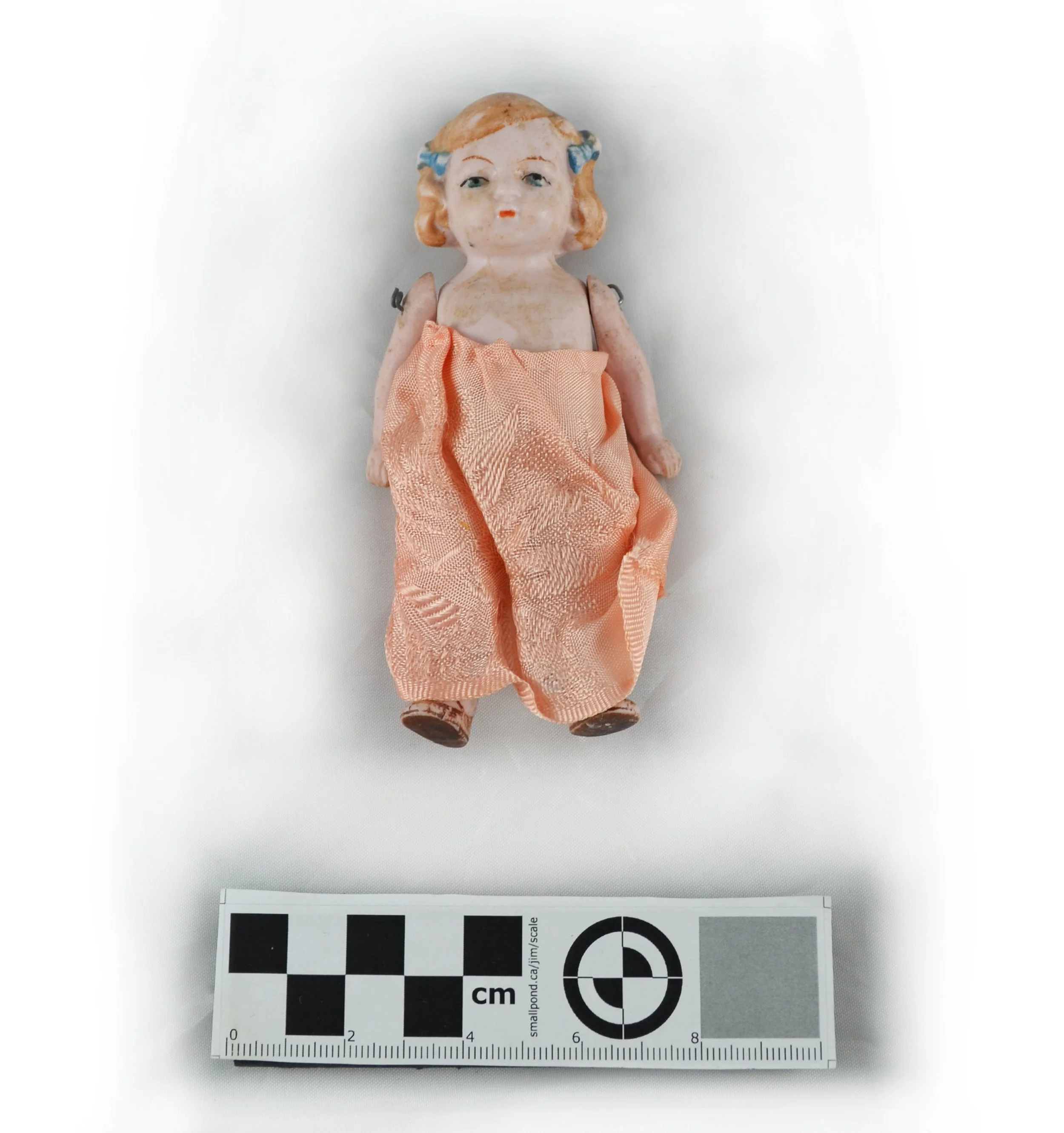
Porcelain Doll / Poupée de porcelaine
Porcelain Doll, c. 1900 / Poupée de porcelaine, vers 1900
SMAS#2013-038-004

Porcelain Doll, c. 1900 / Poupée de porcelaine, vers 1900, SMAS#2013-038-004
ID: An old porcelain doll with a painted face and two blue bows painted on its yellow-painted hair. The doll is wrapped in a coral pink piece of fabric. It is laying against a bright white background with a small measuring tool underneath.
Description: Vieille poupée de porcelaine avec le visage peint et deux nœuds bleus peints sur ses cheveux eux-mêmes peints en jaunes. La poupée est enveloppée dans un morceau de tissu rose corail. Elle est appuyée sur un fond blanc brillant avec un petit instrument de mesure dessous.
What is it about old dolls that makes them a little spooky? Is it the wear-and-tear? Or their resemblance to us? No matter how you feel about them, the truth is that most of them once belonged to a child who adored that doll. In fact, the derelict appearance of most old dolls usually came from years of play. And even after they get worn out, their sentimental value means that they are likely to be held on to for years or even generations.
Take for example this doll – one of the oldest in our collection – that once belonged to Lily Ann Koester (née Manning), born in 1895. Lily’s doll is entirely made of porcelain, save for the wire that connects her moving limbs to her body. Her cherub-like face, hair with bows, and shoes are painted on. Wrapped around her is a piece of satin fabric, loosely handstitched into a simple “dress.”
Lily was the daughter of John and Ann Manning, originally from Devonshire, England. John Manning arrived in Canada sometime before 1879, at which time he relocated from Spence’s Bridge to the Nicola Valley. He married Ann in 1894 and the couple started their family at their Agate Ranch in Dot, B.C. on the Nicola River.
The Mannings had six children, most of whom eventually settled in Summerland. Lily’s brother Tom ran Manning’s Lumber for many years and her brother John worked at the Summerland Research Station. Lily herself eventually relocated to Summerland – along with her small, porcelain doll.
Lily Koester passed away in 1985. She is laid to rest in the Canyon View Cemetery in Summerland. The doll eventually made its way into the hands of her niece, who then donated it to the Museum for the enjoyment of future generations.
-
This project is made possible by the Government of Canada.
//
Les poupées anciennes sont toujours un peu effrayantes. Est-ce dû à l’usure ou au fait qu’elles nous ressemblent? Quelle que soit l’impression qu’elles produisent, le fait est qu’un jour elles ont appartenu à des enfants qui les adoraient. En fait, l’état délabré de la plupart d’entre elles est généralement dû à des années de jeu. Et même lorsqu’elles sont usées, on les garde encore parfois pendant des années, voire des générations, pour des raisons sentimentales.
C’est le cas de cette poupée, une des plus anciennes de notre collection, qui a appartenu à Lily Ann Koester (née Manning) qui est née en 1895. La poupée de Lily est entièrement faite de porcelaine à l’exception des fils de fer qui rattachent ses membres mobiles à son corps. Son visage chérubin, ses cheveux ornés de nœuds et ses chaussures sont peints. Elle est enveloppée dans un morceau de satin grossièrement cousu à la main qui lui sert de « robe ».
Lily était la fille de John et Ann Manning originaires du Devonshire, en Angleterre. John Manning arrive au Canada avant 1879, date à laquelle il quitte Spence’s Bridge pour s’installer dans la Nicola Valley. Il épouse Ann en 1894 et le couple fonde une famille dans le Agate Ranch de Dot (C.-B.) près de la Nicola River.
Les Manning ont six enfants dont la plupart s’installeront à Summerland. Le frère de Lily, Tom, dirigera la société Manning’s Lumber pendant des années et son autre frère, John, travaillera au Centre de recherche de Summerland. Lily elle-même finira par s’installer à Summerland... avec sa petite poupée de porcelaine.
Lily Koester décède en 1985. Elle repose au Canyon View Cemetery de Summerland. C’est sa nièce qui a finalement récupéré sa poupée avant d’en fait don au Musée pour le plaisir des générations suivantes.
-
Ce projet a été rendu possible par le gouvernement du Canada.

G.F. Sinclair Stencil / Pochoir G.F. Sinclair
G.F. Sinclair Stencil, n.d. / Pochoir G.F. Sinclair, sans date
SMAS#1995-060-001

G.F. Sinclair Stencil, n.d. / Pochoir G.F. Sinclair, sans date, SMAS#1995-060-001
ID: A thin, rectangle-shaped piece of metal with uneven edges and a hole in the top left corner. Cut out from the centre of the shape are the stencil letters “G.F. SINCLAIR.” It is mostly dark brown with brassy sections and slight rust on the right side. It is set against a bright white background.
Description : Mince pièce de métal rectangulaire avec des bords inégaux et un trou dans le coin supérieur gauche. Au centre de la pièce, les lettres « G.F. SINCLAIR » sont découpées pour servir de pochoir. La pièce est essentiellement brun foncé avec quelques sections cuivrées et un peu de rouille sur le côté droit. Elle est présentée sur un fond blanc brillant.
This metal stencil, with its uneven edges and discolouration, was once used to mark apple boxes with the orchardist’s name. That orchardist was George Fraser Sinclair (1869 – 1949). George was born in Toronto, ON to Scottish parents. In 1905, at age 34, George arrived in Summerland where he purchased 10 acres from the Summerland Development Co.
George remained a bachelor his whole life. In 1914 he was joined in Summerland by his sister Janet (1865-1944, known as “Jenny”). It is said that she devoted her life to missionary work and had been in India before ill health prompted her to join her brother in Summerland. The pair lived in George’s home, now known as the Sinclair heritage house on Wright Street.
When George died, his only living relative was a niece from Ontario. She travelled to Summerland to settle his affairs. Seemingly, she had little attachment to his belongings as they remained in the house. In the 1950s the house was bought by the Durick family, who held on to the Sinclair family belongings for several decades before eventually donating them to the Summerland Museum.
Ironically - for the amount of Sinclair items in the Museum’s collection – we know relatively little about the personal lives of George Sinclair and his family. Still, Sinclair is honored in town as one of our “old-timers.” His death was mourned in 1949 as the loss of a pioneer. Today, the Sinclair home sits upon the hill, relatively unchanged, just off of Sinclair Road.
-
This project is made possible by the Government of Canada.
//
Ce pochoir en métal décoloré avec des bords irréguliers servait autrefois à marquer le nom de l’arboriculteur fruitier sur les caisses de pommes. L’arboriculteur en question était George Fraser Sinclair (1869–1949). George est né à Toronto (ON) de parents écossais. En 1905, à l’âge de 34 ans, George arrive à Summerland où il achète 10 acres à la société Summerland Development Co.
George ne s’est jamais marié. En 1914, sa sœur Janet (1865–1944, aussi appelée « Jenny ») le rejoint à Summerland. On dit qu’elle a consacré sa vie aux œuvres missionnaires et qu’elle était en Inde jusqu’à ce que des problèmes de santé l’obligent à rejoindre son frère à Summerland. Elle habite alors avec son frère dans la maison de celui-ci sur Wright Street, maintenant connue comme la maison patrimoniale Sinclair.
À sa mort, George n’a plus qu’une parente encore vivante, une nièce qui vit en Ontario. Elle vient à Summerland pour régler la succession. Il semble qu’elle ait montré peu d’intérêt pour les affaires de George puisqu’elle les a laissées dans la maison. Dans les années 1950, la maison est achetée par la famille Durick qui conserve les objets appartenant à la famille Sinclair pendant des décennies avant de les donner au Musée de Summerland.
Malgré le nombre important d’objets de la famille Sinclair faisant partie de la collection du Musée, nous savons relativement peu de choses sur la vie de George Sinclair et de sa famille. Il n’en reste pas moins que Sinclair est honoré dans notre ville comme l’un de ses « anciens ». Lorsqu’il meurt en 1949, on le célèbre comme un pionnier. Aujourd’hui, la maison Sinclair est toujours sur la colline, tout près de Sinclair Road et elle n’a pas beaucoup changé.
-
Ce projet a été rendu possible par le gouvernement du Canada.
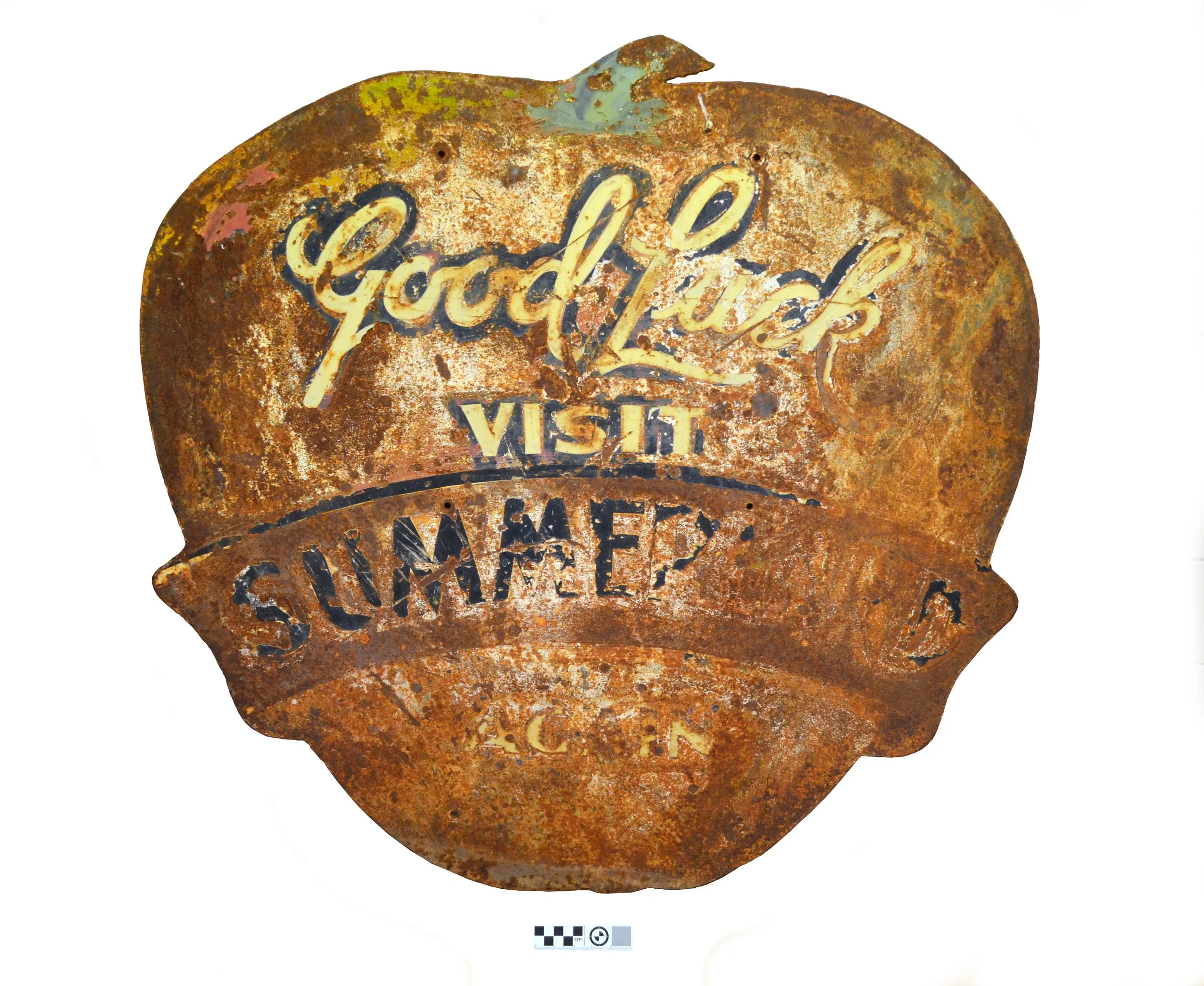
Original Stone Cairn Marker / Panneau original du cairn de pierre
Original Apple-shaped Sign from Roadside Stone Cairn Marker, 1939
Panneau original en forme de pomme provenant du cairn de pierre placé au bord de la route, 1939
SMAS#2022-010-001

Original Apple-shaped Sign from Roadside Stone Cairn Marker, 1939 / Panneau original en forme de pomme provenant du cairn de pierre placé au bord de la route, 1939, SMAS#2022-010-001
ID: A heavily rusted apple-shaped metal sign with remnants of paint that reads “Good Luck – Visit Summerland Again” against a white background.
Description : Panneau métallique en forme de pomme très rouillé avec des restes de peinture indiquant « Good Luck – Visit Summerland Again », sur fond blanc.
Look familiar? If you drive along Highway 97 in Trout Creek or Bentley Road in the Jones Flat neighborhood you may notice a charming fieldstone cairn topped with red, apple-shaped signs. One side reads "Welcome to Summerland" - the reverse reads "Good Luck - Visit Summerland Again."
This is one of two fieldstone cairns built in 1939 and financed by lumber executive John (Jack) McDonald of New Westminster. His family frequently visited the area and became quite fond of it. Building these cairns was an expression of his affection for our town.
These roadside markers sat at the entrances to town – Trout Creek to the south and Bentley Road to the north. Until the 1950s, the highway followed the lakeshore through Lower Town (now Lakeshore Drive) and up Peach Orchard Road to West Summerland on the flat. It then continued out of town down Bentley Road towards Peachland. The cairn on Bentley Road had a small “West” written above Summerland.
Over the years, these cairns have been the site of many “photo-ops”. The Summerland Museum and Archives has a few such photos in our collection. Unfortunately the West Summerland cairn was the site of an unpleasant memory – during World War Two an anonymous resident placed on the cairn a sign reading “Japanese & Germans – Keep Out of Summerland.” This did not represent the opinions of the majority of Summerland residents though and it was swiftly removed.
At some point, the signs disappeared, leaving the stone cairns bare. Due to the efforts of the Heritage Advisory Commission, volunteers, and living relatives of Jack MacDonald, replicas of the original signs were installed in 2013.
This summer, both “Good Luck – Visit Summerland Again” signs were donated to the Summerland Museum and Archives. Seen here is the original sign from the Trout Creek Cairn – the other has a faint trace of the “West” that identifies it as the Bentley Road cairn. It is made of thick metal, with remnants of the paint that once decorated it. There are four holes where bolts would have attached it to the cairn.
We are very happy to preserve these iconic pieces of Summerland history. However, we wonder: what happened to the other half of the signs? Are they out there somewhere?
-
This project is made possible by the Government of Canada.
//
Cet objet vous dit quelque chose? Si vous traversez la ville en voiture, vous remarquerez deux charmants cairns surmontés de panneaux rouges en forme de pomme. D’un côté on peut lire « Welcome to Summerland » (Bienvenue à Summerland), de l’autre « Good luck - Visit Summerland Again » (Bonne continuation et à bientôt!).
Ces cairns ont été édifiés en 1939 et financés par un marchand de bois, John (Jack) McDonald de New Westminster. Sa famille venait souvent dans la région qu’elle appréciait beaucoup. L’édification de ces cairns était une manière pour lui d’exprimer son affection pour notre ville.
Ces panneaux étaient installés aux entrées de la ville, à Trout Creek et sur Bentley Road. Jusqu’aux années 1950, la highway suivait le bord du lac, passait par Lower Town, remontait Peach Orchard jusqu’à West Summerland, puis allait vers Peachland le long de Bentley Road. Le cairn installé à Bentley Road indiquait « West Summerland ».
Au fil des années, ces cairns ont servi de décor à bien des prises de vue. Malheureusement le cairn de West Summerland a aussi été le théâtre d’un événement regrettable; pendant la Seconde Guerre mondiale, un résident anonyme a placé sur le cairn une pancarte qui disait : « Les Japonais et les Allemands, dehors! ». Bien sûr, cela ne représentait pas l’opinion de la majorité des résidents de Summerland et la pancarte a été rapidement retirée.
À un moment, les panneaux ont été retirés des cairns qui sont restés nus. Grâce au travail de la Commission consultative sur le patrimoine, aux bénévoles et aux descendants de Jack McDonald, les cairns ont été restaurés en 2013.
Cet été, les panneaux « Good Luck – Visit Summerland Again » ont été donnés au Musée de Summerland. On voit ici le panneau original placé sur le cairn de Trout Creek; l’autre garde une vague trace du mot « West » qui indique qu’il s’agissait du panneau de Bentley Road. Il est en métal épais avec quelques restes de la peinture qui l’ornait autrefois. Quatre trous indiquent l’emplacement des boulons qui servaient à le fixer au cairn.
-
Ce projet a été rendu possible par le gouvernement du Canada.
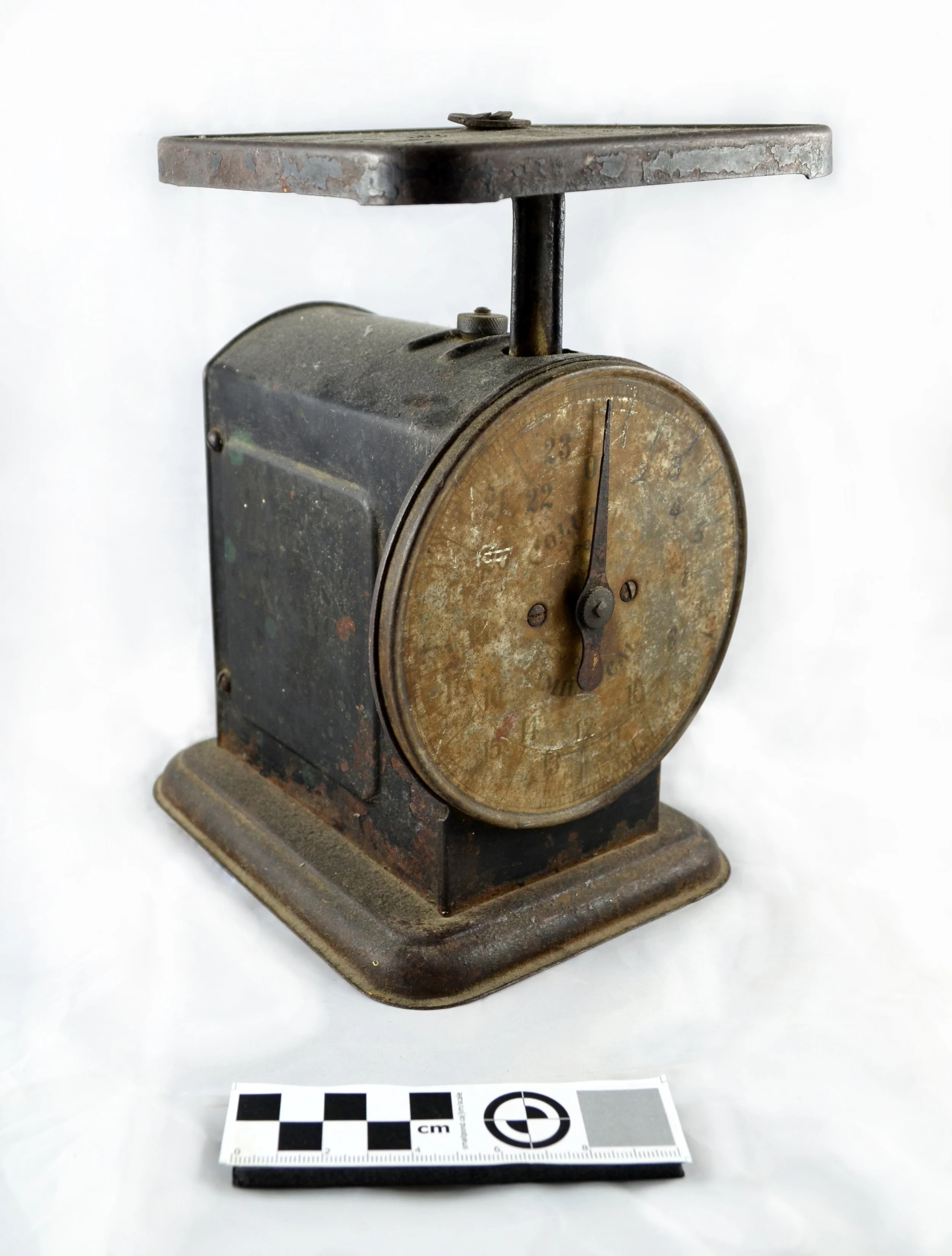
Dial Scale / Bascule à cadran
Dial scale, c. 1906 / Bascule à cadran, vers 1906
SMAS#2022-009-001

Dial Scale, c. 1906 / Bascule à cadran, vers 1906, SMAS#2022-009-001
ID: An old, rusty dial scale against a white background.
Description : Bascule à cadran ancienne rouillée sur fond blanc.
Starting today, we are kicking off a year of Artifact Stories. Our first feature looks at the story behind this weathered dial scale, which was recently donated to our collection.
The scale is made of metal with black paint still clinging to it despite the onset of rust. The dial face is obscured by age, but we can faintly read the words “Columbia Family Scale.” Upon closer inspection, the numbers 1 – 8 have been scratched into the surface of the dial.
This line of scales was produced by Landers, Frary & Clark, a housewares company based out of Connecticut. Similar models can be found online that are dated to 1906. But what does it have to do with Summerland history?
Thankfully, the artifact donor provided us with enough information to situate it in our local history. This scale was used by Aubrey “Red” Beggs at his fruit stand. His son, Randy, remembers his dad using it at the fruit stand in the 1960s to weigh small quantities of fruit. Even at that time, the scale would have been quite old!
Nearly as old as the scale is the history of the Beggs family in Summerland. Samuel and Josephine Beggs moved to Summerland in 1913 with their infant son Gordon. A few years later, their second son Montgomery Aubrey Beggs was born – although he would be known by the nickname “Red.” Both of the Beggs boys would grow up to be Summerland fruit growers.
The Beggs family were among the first to set up a fruit stand when the new highway was put through town. The Begg’s Fruit Stand opened in 1953, near the intersection of Highway 97 and Jones Flat Road. Red would open up his own fruit stand – called “Red’s Fruit Basket” – just across the highway from his brother’s stand.
This artifact helps us remember the history of Summerland’s iconic fruit stands, but also sparks interest in the people who played important roles in our community. Though Red passed away in 1979 and Gordon in 1994, the brothers are still remembered fondly by many Summerland citizens.
We hope that you enjoyed learning about the story behind this artifact – look for our next Artifact Story next Friday!
-
This project is made possible by the Government of Canada.
//
Bascule à cadran, vers 1906
Aujourd’hui, nous entamons une année pendant laquelle nous raconterons l’histoire d’un objet. Nous commençons par l’histoire de cette bascule à cadran patinée par le temps qui a récemment rejoint notre collection.
La bascule est faite de métal sur lequel on aperçoit encore un peu de peinture noire malgré la rouille. Le cadran de la bascule est devenu opaque mais on peut encore y lire les mots « Columbia Family Scale ». En regardant de plus près, on voit que les chiffres de 1 à 8 ont été gravés sur la surface du cadran.
Ce type de bascules était fabriqué par Landers, Frary & Clark, entreprise d’articles ménagers du Connecticut. On trouve des modèles similaires en ligne qui datent de 1906. Mais quel est donc le rapport avec l’histoire de Summerland?
Heureusement, le donateur de cet objet nous a donné assez de renseignements pour le resituer dans notre histoire locale. Cette bascule était utilisée par Aubrey « Red » Beggs dans son stand de fruits. Son fils, Randy, se souvient quand son père l’utilisait dans les années 1960 pour peser de petites quantités de fruits pour ses clients. Déjà à cette époque, la bascule était une antiquité!
L’histoire de la famille Beggs remonte presque aussi loin que celle de la bascule. Samuel et Josephine Beggs s’installent à Summerland en 1913 avec leur jeune fils Gordon. Quelques années plus tard naît leur second fils, Montgomery Aubrey Beggs qu’on appellera « Red ». Les deux fils Beggs deviendront des cultivateurs fruitiers à Summerland.
La famille Beggs est l’une des premières à avoir ouvert un stand de fruits lorsque la nouvelle « highway » a desservi la ville. Le stand de fruits de la famille Beggs ouvre en 1953 près du croisement entre la Highway 97 et Jones Flat Road. Red ouvre ensuite son propre stand de fruits qu’il nomme « Red’s Fruit Basket » de l’autre côté de la highway, face au stand de son frère.
Cet objet nous rappelle l’histoire iconique des stands fruitiers de Summerland et nous en apprend davantage sur des personnes qui ont joué un rôle important dans notre communauté. Même si Red est décédé en 1979 et Gordon en 1994, de nombreux habitants de Summerland gardent un excellent souvenir des deux frères.
Nous espérons que l’histoire de cet objet vous a plu. Ne manquez pas la prochaine histoire que nous vous raconterons vendredi prochain!
-
Ce projet a été rendu possible par le gouvernement du Canada